Introduction
Generative AI has transformed how businesses build intelligent applications. Whether it’s AI chatbots, content generation, image creation, document summarization, or enterprise knowledge assistants, organizations are rapidly adopting Large Language Models (LLMs).
However, integrating multiple AI models into applications isn’t always straightforward. Every provider has different APIs, authentication mechanisms, pricing models, and deployment approaches.
This is where Amazon Bedrock comes in.
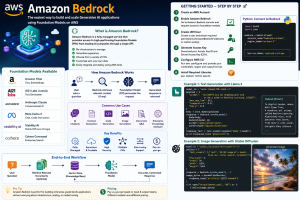
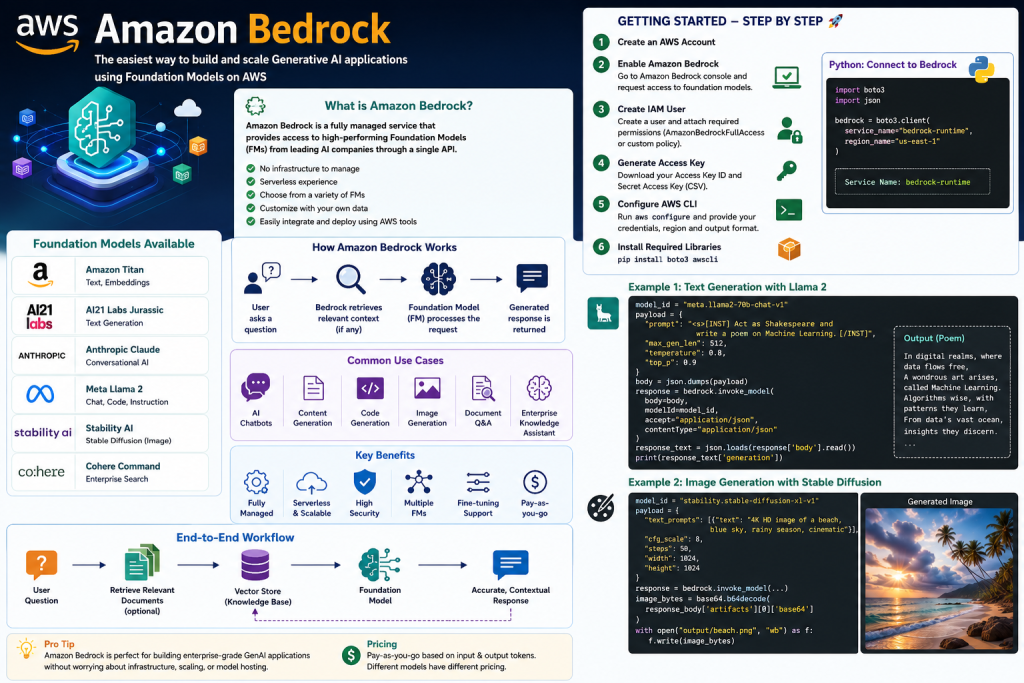
Amazon Bedrock is a fully managed AWS service that enables developers to build, scale, and deploy Generative AI applications using foundation models from leading AI companies through a single API.
Instead of integrating multiple AI platforms individually, Amazon Bedrock provides one unified interface to access some of the world’s most powerful AI models.
What is Amazon Bedrock?
Amazon Bedrock is a fully managed serverless service offered by AWS that allows developers to access Foundation Models (FMs) from multiple AI providers without managing infrastructure.
Using Amazon Bedrock, developers can:
- Build Generative AI applications
- Generate text
- Generate images
- Build chatbots
- Create enterprise AI assistants
- Summarize documents
- Generate code
- Perform question answering
- Fine-tune supported foundation models
All through AWS infrastructure.
Unlike self-hosting large models, Bedrock eliminates the complexity of infrastructure provisioning, GPU management, scalability, and deployment.
Why Amazon Bedrock?
Today’s AI ecosystem contains multiple model providers:
- Amazon Titan
- Anthropic Claude
- Meta Llama
- AI21 Labs Jurassic
- Stability AI Stable Diffusion
- Cohere Command
Each provider exposes different APIs and integration patterns.
Amazon Bedrock simplifies this by offering a unified API that allows developers to switch between models with minimal code changes.
Instead of learning five different SDKs, developers learn one.
Foundation Models Supported by Amazon Bedrock
Amazon Bedrock provides access to several leading Foundation Models, including:
Amazon Titan
Ideal for:
- Text generation
- Embeddings
- Enterprise AI
- Knowledge retrieval
Anthropic Claude
Designed for:
- Conversational AI
- Long-context reasoning
- Document analysis
- Content generation
Meta Llama
Excellent for:
- Chatbots
- Code generation
- Question answering
- Instruction following
Stability AI Stable Diffusion
Used for:
- AI image generation
- Marketing creatives
- Product visualization
- Design concepts
AI21 Jurassic
Useful for:
- Content writing
- Summarization
- Text generation
Cohere Command
Popular for:
- Enterprise search
- Knowledge assistants
- Text understanding
Typical Use Cases
Amazon Bedrock can be used for numerous business applications.
AI Chatbots
Create intelligent customer support systems capable of answering natural language questions.
Examples include:
- Banking support
- HR assistants
- Healthcare bots
- IT helpdesk
Content Generation
Generate:
- Blogs
- Emails
- Product descriptions
- Marketing content
- Social media posts
Document Intelligence
Build assistants capable of answering questions from:
- PDFs
- Contracts
- Research papers
- Policies
- Technical manuals
Code Generation
Generate:
- Python
- Java
- JavaScript
- SQL
- CloudFormation
- Terraform
Image Generation
Generate images using Stable Diffusion from simple text prompts.
Example:
Generate a 4K cinematic beach at sunrise with blue skies.
Amazon Bedrock Architecture
A simplified architecture looks like this:
Application
      │
      ▼
Amazon Bedrock API
      │
      ▼
Foundation Model
      │
      ▼
Generated Response
Developers interact only with Bedrock.
AWS handles:
- Model hosting
- Scaling
- Security
- High availability
- Infrastructure
- API management
Setting Up Amazon Bedrock
Before writing code, complete the following setup.
Step 1
Create an AWS Account.
Step 2
Open Amazon Bedrock in the AWS Console.
Step 3
Choose a supported region such as:
- us-east-1
- us-west-2
Step 4
Request access to the Foundation Models.
Initially, models remain disabled.
Navigate to:
Model Access → Request Access
Once approved, the models become available.
Creating an IAM User
For programmatic access:
- Open IAM.
- Create a new user.
- Assign the required permissions.
- Generate an Access Key.
- Download the credentials securely.
These credentials allow your application to communicate with AWS services.
Installing Required Libraries
Install the required Python packages.
pip install boto3
pip install awscli
Or create a requirements file.
boto3
awscli
Then install:
pip install -r requirements.txtConfigure AWS CLI
Run:
aws configureProvide:
- Access Key
- Secret Access Key
- AWS Region
- Output Format (JSON)
After configuration, your application can securely authenticate with Amazon Bedrock.
Connecting to Amazon Bedrock
Using Python and Boto3:
import boto3

client = boto3.client(
    service_name="bedrock-runtime"
)
This creates a Bedrock Runtime client used to invoke Foundation Models.
Working with Llama Models
A typical request includes:
- Prompt
- Model ID
- Content Type
- Accept Type
Example prompt:
Act as Shakespeare and write a poem about Machine Learning.
The payload is converted into JSON before invoking the model.
The response contains generated text that can be displayed directly in the application.
Working with Claude
Claude follows a similar workflow.
The primary difference lies in:
- Prompt format
- Payload structure
- Response schema
Once configured correctly, Claude produces high-quality conversational responses suitable for enterprise assistants.
AI Image Generation Using Stable Diffusion
Amazon Bedrock also supports image generation.
Example prompt:
Generate a 4K HD cinematic image of a beach during sunrise with blue skies.
The API returns a Base64-encoded image.
Developers simply:
- Decode the Base64 string.
- Convert it into bytes.
- Save it as a PNG file.
Within seconds, a high-quality AI-generated image is ready for use.
Pricing
Amazon Bedrock follows a pay-as-you-use pricing model.
Charges depend on:
- Input tokens
- Output tokens
- Selected Foundation Model
Different models have different pricing structures.
This makes it easy to start small while scaling as demand increases.
Benefits of Amazon Bedrock
Organizations choose Bedrock because it provides:
- Fully managed infrastructure
- Serverless architecture
- Enterprise-grade security
- Easy API integration
- Multiple Foundation Models
- High scalability
- Fine-tuning capabilities
- Private enterprise deployment
- AWS ecosystem integration
Best Practices
When building production applications:
- Use IAM roles instead of root credentials.
- Store secrets securely using AWS Secrets Manager.
- Validate user prompts.
- Monitor API usage with CloudWatch.
- Cache responses where appropriate.
- Choose the right model for the use case.
- Implement retry mechanisms for transient failures.
- Control costs through token optimization.
Real-World Use Cases
Organizations are already using Amazon Bedrock for:
- Enterprise AI assistants
- HR chatbots
- Customer support automation
- Knowledge base search
- RAG applications
- Financial document analysis
- Healthcare assistants
- AI-powered coding assistants
- Marketing content generation
- Image generation
Conclusion
Amazon Bedrock significantly simplifies the development of Generative AI applications by providing a unified, fully managed platform for accessing industry-leading Foundation Models.
Whether you’re building intelligent chatbots, document Q&A systems, image generation tools, enterprise knowledge assistants, or Retrieval-Augmented Generation (RAG) solutions, Bedrock removes the operational complexity of managing AI infrastructure while allowing developers to focus on building innovative applications.
For AWS developers, cloud architects, and AI engineers, learning Amazon Bedrock is becoming an essential skill as enterprises increasingly adopt Generative AI into their products and workflows.
Tags :
Amazon Bedrock, AWS Bedrock, Generative AI, Foundation Models, Amazon Titan, Anthropic Claude, Meta Llama, Stable Diffusion, AI21 Jurassic, Cohere Command, AWS, Boto3, Python, AWS CLI, IAM, Cloud Computing, Artificial Intelligence, Machine Learning, Large Language Models, LLM, AI Chatbot, Image Generation, Text Generation, RAG, Retrieval Augmented Generation, Prompt Engineering, AI Development, AWS AI, Serverless AI, Cloud AI
About The Author