Introduction
Large Language Models (LLMs) such as GPT, Claude, Gemini, and Llama have transformed the way organizations interact with information. They can generate human-like responses, write code, summarize documents, and answer complex questions. However, one major limitation remains: they only know what they were trained on.
What happens when you want an AI assistant to answer questions using your company’s confidential documents, the latest business reports, technical manuals, or real-time project data?
This is where Retrieval-Augmented Generation (RAG) comes into play.
Rather than relying solely on the LLM’s pre-trained knowledge, RAG retrieves relevant information from your organization’s knowledge sources and uses that information to generate accurate, contextual, and trustworthy responses.
Simply put:
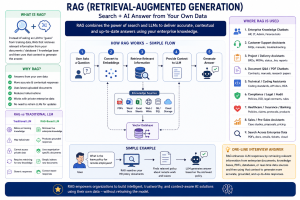
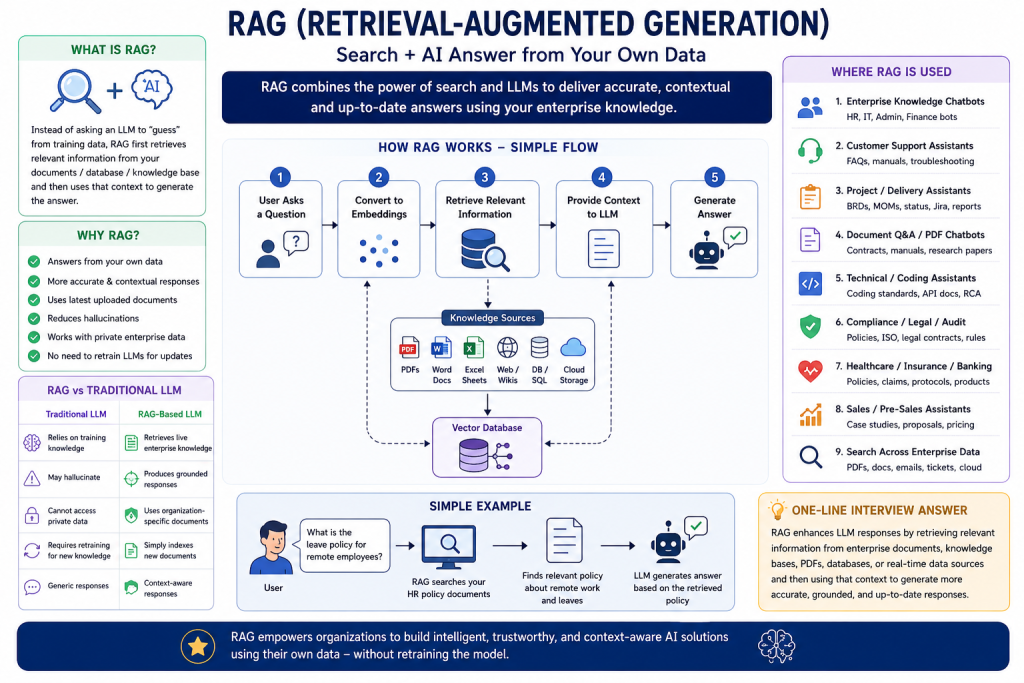
RAG = Search + AI Answer
Instead of asking an LLM to “guess,” RAG first searches for relevant information and then generates an answer using that retrieved context.
Why Do We Need RAG?
Although modern LLMs are incredibly powerful, they have several limitations when used in enterprise environments.
Without RAG, an LLM:
- May generate generic responses.
- Can hallucinate facts.
- Has no knowledge of your organization’s private documents.
- Cannot access newly created business information.
- Cannot reliably answer questions from confidential data.
RAG overcomes these challenges by grounding responses in trusted enterprise content.
How Does RAG Work?
A typical RAG pipeline consists of five simple steps:
Step 1: User Asks a Question
Example:
What is the leave policy for employees working remotely?
Step 2: Convert the Query into Embeddings
The user’s question is converted into vector embeddings using an embedding model.
These embeddings capture the semantic meaning of the query rather than relying solely on keyword matching.
Step 3: Retrieve Relevant Documents
The generated embeddings are matched against a vector database or document repository.
The system retrieves the most relevant document chunks from sources such as:
- PDFs
- Word documents
- Excel sheets
- Internal wikis
- SharePoint
- Amazon S3
- Google Drive
- Confluence
- Knowledge bases
Step 4: Provide Context to the LLM
Instead of sending only the user’s question, the retrieved document content is included as context.
This ensures that the model answers using verified enterprise information.
Step 5: Generate the Final Response
The LLM generates a grounded answer based on both:
- The user’s question
- The retrieved enterprise knowledge
The result is significantly more accurate, relevant, and trustworthy.
RAG Architecture
A simplified RAG workflow looks like this:
User Question
       │
       ▼
Embedding Model
       │
       ▼
Vector Database
       │
Relevant Document Chunks
       │
       ▼
Large Language Model (LLM)
       │
       ▼
Accurate AI Response
Common Enterprise Use Cases of RAG
1. Enterprise Knowledge Chatbots
Organizations use RAG to build internal AI assistants capable of answering employee questions using official company documentation.
Typical examples include:
- HR policies
- Salary information
- PF and tax guidelines
- Leave policies
- Reimbursement rules
2. Customer Support Assistants
Customer support bots use RAG to retrieve answers directly from manuals, FAQs, troubleshooting guides, and product documentation.
Example questions include:
- How do I reset my password?
- What is the refund policy?
- How can I configure this feature?
Because responses come from approved documentation, hallucinations are significantly reduced.
3. Project Management Assistants
Development teams often store information across multiple project artifacts.
RAG enables natural language search across:
- Business Requirement Documents (BRDs)
- Minutes of Meeting (MoMs)
- Release notes
- Sprint reports
- Jira exports
- Technical specifications
Users can ask questions like:
- What is the current status of Project X?
- Which blockers are open?
- What was delivered in Sprint 12?
4. Document Question Answering
Instead of reading hundreds of pages manually, users can interact with documents conversationally.
Popular document sources include:
- Research papers
- Contracts
- Books
- Technical manuals
- Company policies
- Training material
5. Technical Learning Assistants
Engineering teams can build AI assistants capable of answering technical questions from internal documentation.
Examples include:
- Coding standards
- API documentation
- Incident reports
- Solution designs
- Architecture documents
Example queries:
- How do we integrate Kafka with Node.js?
- What caused the previous production issue?
- Which authentication standard do we follow?
6. Compliance and Legal Knowledge Systems
Industries with strict regulatory requirements depend heavily on accurate documentation.
RAG enables AI assistants that answer exclusively from approved compliance documents.
Common domains include:
- ISO standards
- Audit documentation
- Legal contracts
- Financial regulations
- Tax policies
7. Healthcare, Insurance, and Banking
Highly regulated industries require AI systems that generate responses from verified knowledge rather than model memory.
Common applications include:
- Insurance policy explanation
- Claim processing assistants
- Medical protocol lookup
- Banking product guidance
8. Sales and Pre-Sales Assistants
Sales teams spend significant time searching for proposal templates, product documentation, pricing information, and case studies.
RAG enables instant retrieval of:
- Product features
- Customer case studies
- Proposal templates
- Pricing documents
- Implementation guides
9. Enterprise Search Across Unstructured Data
Business knowledge is often scattered across multiple platforms.
RAG unifies search across:
- PDFs
- Word documents
- Excel files
- Emails
- Helpdesk tickets
- SharePoint
- Confluence
- Amazon S3
- Google Drive
Employees can search everything using natural language instead of manually browsing files.
Benefits of RAG
Organizations adopt Retrieval-Augmented Generation because it offers significant advantages:
- Improves response accuracy
- Reduces hallucinations
- Uses the latest uploaded documents
- Provides contextual answers
- Supports private enterprise knowledge
- Eliminates the need to retrain LLMs after every document update
- Scales efficiently across multiple knowledge sources
- Improves trust in AI-generated responses
RAG vs Traditional LLM
| Traditional LLM | RAG-Based LLM |
|---|---|
| Relies on training knowledge | Retrieves live enterprise knowledge |
| May hallucinate | Produces grounded responses |
| Cannot access private data | Uses organization-specific documents |
| Requires retraining for new knowledge | Simply indexes new documents |
| Generic responses | Context-aware responses |
One-Line Interview Answer
Retrieval-Augmented Generation (RAG) enhances Large Language Models by retrieving relevant information from enterprise documents, knowledge bases, PDFs, databases, or real-time data sources before generating accurate, contextual, and up-to-date responses.
Resume-Friendly Definition
Implemented Retrieval-Augmented Generation (RAG) solutions to build enterprise AI assistants capable of answering questions from private knowledge bases, project documentation, policies, manuals, and business records while reducing hallucinations and improving response relevance.
Conclusion
Retrieval-Augmented Generation has become one of the most important architectural patterns for enterprise AI. Instead of depending solely on an LLM’s pre-trained knowledge, RAG combines semantic search with generative AI to deliver responses grounded in trusted business information.
Whether you’re building an HR chatbot, customer support assistant, compliance system, project knowledge portal, or enterprise search engine, RAG enables organizations to create scalable, intelligent, and trustworthy AI solutions without repeatedly retraining large language models.
As enterprises continue adopting Generative AI, mastering RAG is quickly becoming an essential skill for AI engineers, solution architects, and cloud professionals.
Tags :
RAG, Retrieval Augmented Generation, Generative AI, Large Language Models, LLM, Vector Database, Embeddings, LangChain, AI Chatbot, Enterprise AI, Knowledge Base, Semantic Search, Document AI, PDF Chatbot, AI Assistant, Vector Search, OpenAI, AWS Bedrock, Pinecone, ChromaDB, FAISS, AI Architecture, Machine Learning, Artificial Intelligence, Enterprise Search, LangGraph, Retrieval Systems, NLP, Prompt Engineering, AI Engineering
About The Author