Introduction
Computer vision has transformed the way machines perceive and understand the world. From autonomous vehicles and industrial automation to healthcare diagnostics and intelligent surveillance, modern AI systems increasingly rely on object detection to interpret visual information in real time.
Among all object detection frameworks developed over the past decade, YOLO (You Only Look Once) has emerged as one of the most revolutionary and influential innovations in deep learning. Since its introduction in 2016, the YOLO family has continuously evolved through multiple generations, each improving accuracy, inference speed, scalability, and deployment capabilities.
Today, YOLO powers thousands of commercial AI products across industries, making it one of the most widely adopted computer vision architectures ever created.
This comprehensive guide explores everything about YOLO, including its history, architecture, evolution from YOLOv1 to YOLO27, real-world applications, advantages, limitations, and how modern transformer-based models like RF-DETR are shaping the next generation of object detection.
What is YOLO?
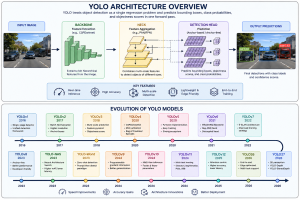
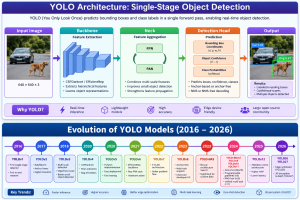
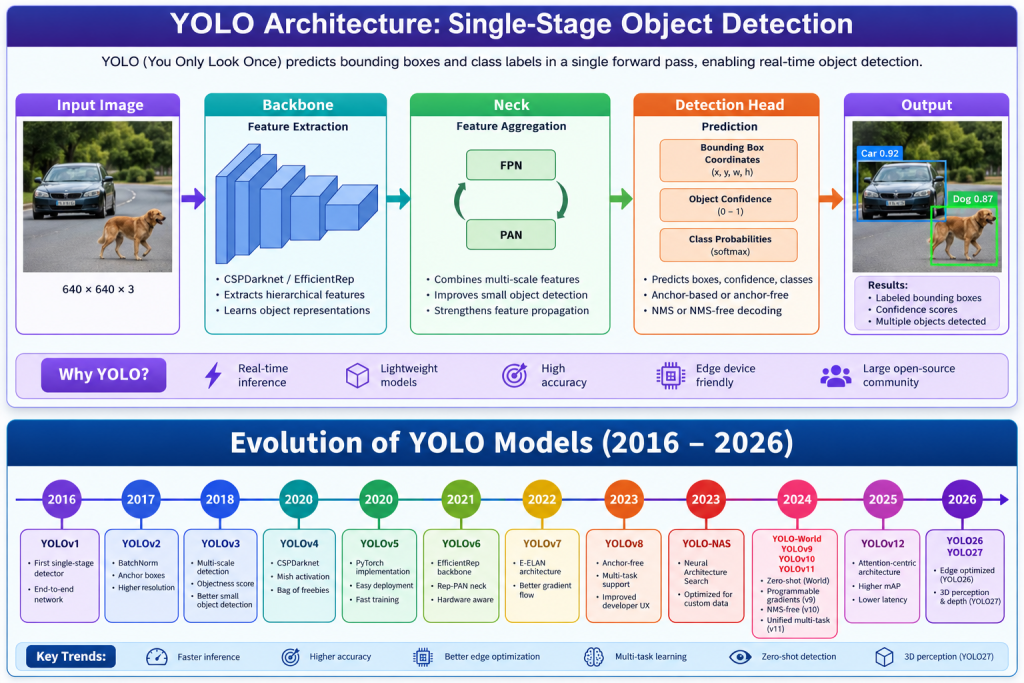
YOLO, short for You Only Look Once, is a family of real-time object detection models that detect and classify multiple objects within an image or video using a single neural network pass.
Unlike traditional computer vision systems that perform object localization and classification separately, YOLO predicts:
- Object locations
- Bounding boxes
- Confidence scores
- Object classes
all at once.
This “single-shot” approach dramatically reduces computational complexity while maintaining excellent accuracy, making YOLO ideal for real-time AI applications.
The Birth of YOLO
The original YOLO architecture was introduced in 2016 by:
- Joseph Redmon
- Santosh Divvala
- Ross Girshick
- Ali Farhadi
The research paper presented at CVPR 2016 fundamentally changed how researchers approached object detection.
Prior to YOLO, object detection was largely dominated by two-stage detectors such as:
- R-CNN
- Fast R-CNN
- Faster R-CNN
Although highly accurate, these models required multiple neural network passes for every image, making them computationally expensive and unsuitable for real-time deployment.
YOLO introduced an elegant solution:
Treat object detection as a single regression problem instead of a multi-stage pipeline.
This innovation made real-time AI vision practical for the first time.
Two-Stage vs Single-Stage Detection
Traditional Two-Stage Detectors
The traditional workflow involves:
- Generate candidate object regions.
- Crop each region.
- Run a classifier.
- Refine bounding boxes.
- Remove duplicate detections.
While accurate, this approach is slow.
YOLO’s Single-Stage Pipeline
YOLO performs:
- Feature extraction
- Bounding box prediction
- Object classification
- Confidence estimation
simultaneously.
One image enters.
One forward pass occurs.
All detections are produced instantly.
This dramatically improves inference speed.
How YOLO Works
The basic YOLO workflow includes:
Step 1: Divide Image into Grid
The image is divided into multiple grid cells.
Each cell becomes responsible for detecting objects whose centers lie inside it.
Step 2: Predict Bounding Boxes
Each grid predicts:
- x coordinate
- y coordinate
- width
- height
along with confidence scores.
Step 3: Predict Classes
Each box receives probabilities for different object categories such as:
- Person
- Dog
- Car
- Bicycle
- Truck
Step 4: Confidence Calculation
Confidence combines:
- Object existence probability
- Localization quality
Higher confidence indicates better predictions.
Step 5: Non-Maximum Suppression (NMS)
Since multiple boxes often overlap, NMS removes duplicate detections while preserving the highest-confidence prediction.
Newer YOLO generations even eliminate this requirement.
Why YOLO Changed Computer Vision
YOLO introduced several revolutionary concepts:
- End-to-end learning
- Real-time inference
- Unified architecture
- High FPS
- Efficient deployment
- Smaller model size
- Better scalability
These innovations enabled AI applications that were previously impossible on consumer hardware.
Evolution of YOLO Models
YOLOv1 (2016)
The first YOLO architecture introduced:
- Single-shot detection
- Unified network
- Real-time performance
Although groundbreaking, it struggled with:
- Small objects
- Localization accuracy
- Dense scenes
YOLOv2 (2017)
YOLOv2 significantly improved performance through:
- Batch normalization
- Higher resolution training
- Anchor boxes
- Better backbone network
Accuracy increased substantially while maintaining impressive speed.
YOLOv3 (2018)
YOLOv3 became one of the most popular versions ever released.
Major improvements included:
- Multi-scale prediction
- Residual connections
- Objectness scores
- Better small object detection
Even today, YOLOv3 remains widely used in research and education.
Life After Joseph Redmon
After YOLOv3, creator Joseph Redmon stepped away from computer vision research.
The YOLO ecosystem continued evolving through contributions from researchers worldwide.
Instead of one official version, multiple independent implementations emerged.
This resulted in rapid innovation across academia and industry.
YOLOv4
Released in 2020, YOLOv4 introduced:
- CSPDarknet backbone
- Mish activation
- Mosaic augmentation
- Improved feature aggregation
- Better training strategies
YOLOv4 became one of the fastest production-grade detectors available.
YOLOv5
Although never officially published as a research paper, YOLOv5 became one of the most widely adopted implementations.
Reasons include:
- PyTorch implementation
- Easy installation
- Simple training
- Lightweight deployment
- Excellent documentation
- Active community support
YOLOv5 popularized AI deployment for developers with limited computer vision experience.
PP-YOLO
Developed by Baidu, PP-YOLO introduced:
- PaddlePaddle framework
- Better backbone networks
- Matrix NMS
- DropBlock regularization
It achieved higher COCO benchmark scores than previous YOLO versions.
Scaled YOLOv4
Scaled YOLOv4 expanded model capacity while preserving efficiency through:
- Cross Stage Partial Networks
- Improved scaling strategies
It targeted enterprise-scale object detection workloads.
PP-YOLOv2
This iteration refined:
- Path Aggregation Networks
- Mish activation
- Training optimizations
delivering incremental performance gains.
YOLOv6
YOLOv6 focused heavily on deployment efficiency.
Key innovations included:
- EfficientRep Backbone
- Rep-PAN Neck
- Anchor-free training
- SIoU loss
- SimOTA assignment
These changes optimized inference for industrial hardware.
YOLOv7
YOLOv7 concentrated on improving gradient flow and computational efficiency.
Innovations included:
- E-ELAN architecture
- Better feature aggregation
- Reduced memory overhead
It achieved state-of-the-art performance upon release.
YOLOv8
YOLOv8 represented a major usability leap.
Features include:
- Anchor-free detection
- Cleaner Python API
- CLI interface
- Classification
- Segmentation
- Pose estimation
YOLOv8 rapidly became one of the most developer-friendly AI frameworks.
YOLO-NAS
YOLO-NAS introduced Neural Architecture Search.
Instead of manually designing networks, AI optimized its own architecture.
Advantages include:
- Higher mAP
- Lower latency
- Better custom dataset performance
YOLO-World
YOLO-World introduced zero-shot object detection.
Instead of training on every category, users simply provide text prompts.
Examples:
- Detect helmets
- Detect drones
- Detect forklifts
- Detect broken pipes
without retraining.
This represents a major shift toward foundation vision models.
YOLOv9
YOLOv9 introduced:
- Programmable Gradient Information
- Improved optimization
- Better feature learning
- Higher COCO benchmark accuracy
YOLOv10
YOLOv10 optimized:
- Lower latency
- Fewer parameters
- Better CPU performance
- NMS-free inference
It achieved remarkable real-time performance with significantly reduced computational requirements.
YOLOv11
YOLOv11 expanded beyond detection.
Supported tasks include:
- Object Detection
- Segmentation
- Classification
- Pose Estimation
- Oriented Bounding Boxes (OBB)
making it a versatile multi-task computer vision framework.
YOLOv12
YOLOv12 shifted attention toward attention-centric architectures.
Benefits include:
- Better contextual understanding
- Lower latency
- Improved accuracy
- Stronger COCO benchmark performance
YOLO26
YOLO26 expanded support for:
- Object Detection
- Segmentation
- Pose Estimation
- OBB Detection
- Image Classification
while emphasizing edge-device deployment.
YOLO27
Expected in 2026, YOLO27 moves beyond traditional 2D object detection.
New capabilities include:
- Monocular depth estimation
- Stereo depth estimation
- 3D perception
- Robotics
- Autonomous navigation
This marks the beginning of YOLO’s transition into spatial AI.
Real-World Applications of YOLO
YOLO is now used across numerous industries.
Autonomous Vehicles
Detect:
- Cars
- Pedestrians
- Traffic lights
- Road signs
- Cyclists
in milliseconds.
Manufacturing
Monitor:
- Assembly lines
- Missing components
- Product defects
- Robotic systems
Healthcare
Assist with:
- Medical imaging
- Surgical navigation
- Disease detection
- Cell analysis
Retail
Enable:
- Smart checkout
- Customer analytics
- Inventory management
- Shelf monitoring
Agriculture
Detect:
- Crop diseases
- Livestock
- Fruit counting
- Weed identification
Smart Cities
Analyze:
- Traffic congestion
- Parking availability
- Crowd monitoring
- Public safety
Industrial Safety
Ensure compliance by detecting:
- Helmets
- Safety vests
- Gloves
- Goggles
- Restricted area access
Wildlife Monitoring
Track:
- Animal movement
- Species identification
- Forest fire smoke
- Illegal poaching
Advantages of YOLO
The popularity of YOLO comes from several strengths:
- Extremely fast inference
- Excellent real-time performance
- Compact models
- Edge deployment support
- Strong community ecosystem
- Continuous innovation
- Easy customization
- Broad hardware compatibility
Limitations of YOLO
Despite its strengths, YOLO has limitations.
These include:
- Challenges with extremely small objects
- Dense object scenes
- Heavy occlusions
- Complex background clutter
- Slightly lower accuracy than the latest transformer-based detectors
For maximum accuracy, transformer architectures increasingly outperform traditional CNN-based YOLO models.
YOLO vs Transformer-Based Object Detection
Recent years have seen the rise of transformer-based detection models.
One prominent example is RF-DETR, which demonstrates:
- Higher Average Precision (AP)
- Better transfer learning
- Stronger performance on small datasets
- Apache 2.0 licensing
- Excellent commercial usability
Unlike some recent YOLO releases that use AGPL licensing, Apache 2.0 provides greater flexibility for enterprise software distribution.
As a result, many organizations now evaluate both YOLO and transformer-based detectors before selecting a production model.
Which YOLO Version Should You Choose?
The answer depends on your requirements.
- For learning and research: YOLOv5 and YOLOv8 remain excellent choices due to their simplicity, documentation, and large community.
- For edge devices: YOLOv10, YOLO26, and lightweight YOLO variants offer excellent speed with minimal hardware requirements.
- For zero-shot detection: YOLO-World enables prompt-based detection without retraining.
- For advanced robotics and 3D perception: YOLO27 represents the next step toward depth-aware AI systems.
- For projects prioritizing maximum detection accuracy: Evaluate transformer-based alternatives such as RF-DETR alongside the latest YOLO models.
The Future of YOLO
YOLO has evolved from a groundbreaking academic paper into one of the world’s most influential computer vision ecosystems. Over the years, it has expanded far beyond simple object detection to support segmentation, pose estimation, oriented bounding boxes, zero-shot recognition, and even emerging 3D perception capabilities.
The future of YOLO will likely be shaped by several trends:
- Greater integration of transformer architectures
- Multi-modal vision-language understanding
- Native support for 3D scene reconstruction
- Edge AI optimization for low-power devices
- Improved zero-shot and open-vocabulary detection
- Smaller, faster, and more accurate foundation models
As AI continues to move from cloud servers to edge devices, drones, robots, smartphones, autonomous vehicles, and industrial IoT systems, YOLO will remain a cornerstone technology for real-time computer vision.
Final Thoughts
YOLO fundamentally transformed object detection by proving that speed and accuracy could coexist within a single, end-to-end neural network. From the original YOLOv1 introduced in 2016 to the anticipated YOLO27 with its 3D perception capabilities, the framework has continually adapted to meet the growing demands of modern AI applications.
Whether you’re building a smart surveillance system, deploying AI on edge hardware, creating autonomous robots, or developing next-generation industrial automation, understanding the evolution and capabilities of the YOLO family provides a strong foundation for success.
While newer transformer-based detectors are pushing the boundaries of accuracy, YOLO continues to thrive because of its exceptional performance, vibrant open-source ecosystem, ease of deployment, and versatility. It remains one of the most practical and influential computer vision frameworks available today, and its impact on real-time AI will continue to shape the future of intelligent vision systems for years to come.
Tags: YOLO, YOLO Models, YOLOv8, YOLOv11, YOLOv12, YOLO26, YOLO27, Object Detection, Computer Vision, Artificial Intelligence, Deep Learning, Machine Learning, OpenCV, PyTorch, Darknet, Real-Time AI, Edge AI, RF-DETR, Neural Networks, AI Applications, Image Recognition, Vision AI, Robotics, Autonomous Vehicles, Industrial AI, AI Model Comparison
About The Author