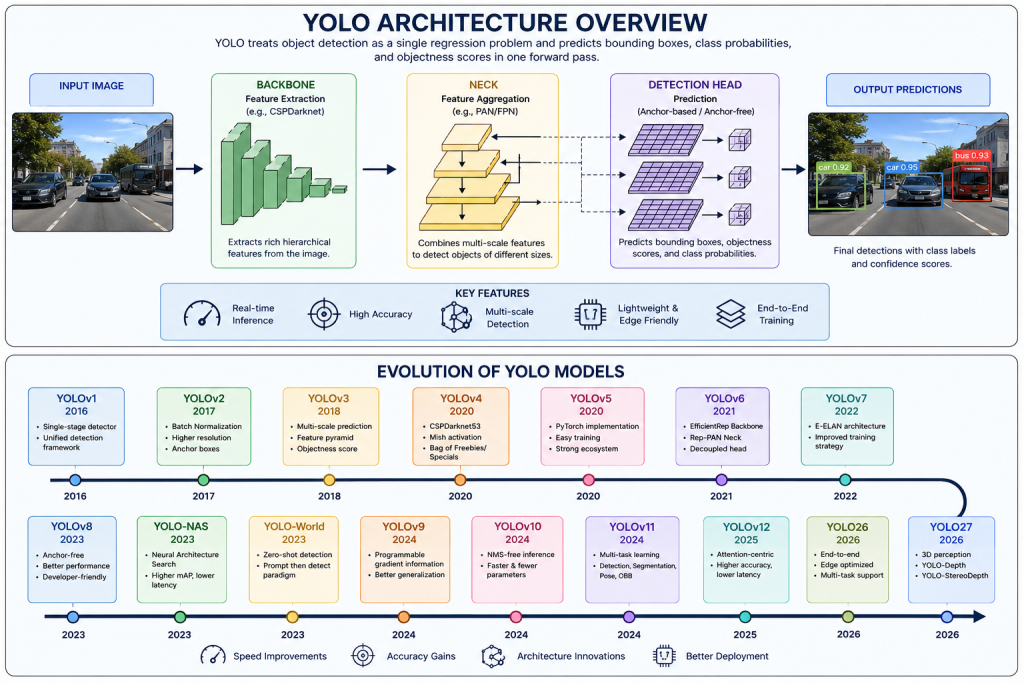
The Ultimate Guide to YOLO Models (2026) | Complete Evolution from YOLOv1 to YOLO27
Learn everything about YOLO object detection models, from YOLOv1 to YOLO27. Explore architecture, comparisons, applications, PyTorch implementation, performance benchmarks, FAQs, and SEO-friendly insights for AI developers.
Table of Contents
Table of Contents
- Introduction
- What is YOLO?
- Why YOLO Revolutionized Computer Vision
- How Object Detection Works
- Two-Stage vs Single-Stage Detection
- YOLO Architecture Explained
- Evolution of YOLO Models
- YOLO Family Timeline
- Comparison Table of All YOLO Models
- YOLO vs Faster R-CNN
- YOLO vs SSD
- YOLO vs DETR
- YOLO vs RF-DETR
- Understanding mAP, IoU, Precision & Recall
- Training Custom YOLO Models
- Dataset Preparation
- Data Annotation
- Data Augmentation
- Transfer Learning
- Hyperparameter Optimization
- Edge AI Deployment
- YOLO in Robotics
- YOLO in Autonomous Driving
- YOLO in Healthcare
- YOLO in Manufacturing
- YOLO in Retail
- YOLO in Agriculture
- Performance Benchmarks
- Advantages
- Limitations
- Future of YOLO
- Frequently Asked Questions
- Final Thoughts
⸻
Introduction
Artificial Intelligence has entered a new era where machines can perceive the world with remarkable accuracy. At the heart of this revolution lies computer vision, enabling machines to detect, classify, and understand visual information.
Among countless object detection algorithms developed over the years, YOLO (You Only Look Once) has become the industry’s gold standard for real-time object detection. Its speed, flexibility, and ease of deployment have made it one of the most widely adopted AI architectures across industries.
Whether you’re building autonomous vehicles, smart surveillance systems, retail analytics platforms, industrial robots, or healthcare imaging solutions, chances are you’ve encountered YOLO.
This guide explores the complete journey of YOLO, from its groundbreaking origins to the latest innovations shaping the future of AI-powered vision.
⸻
What is YOLO?
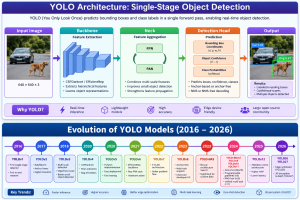
YOLO (You Only Look Once) is a family of deep learning models designed for real-time object detection. Unlike traditional approaches that perform object localization and classification in separate stages, YOLO predicts both simultaneously in a single forward pass.
This unified architecture enables extremely fast inference while maintaining high accuracy, making YOLO ideal for applications where speed is critical.
Core capabilities include:
- Object detection
- Instance segmentation
- Image classification
- Pose estimation
- Oriented bounding box (OBB) detection
- Depth estimation (YOLO27)
⸻
Why YOLO Revolutionized Computer Vision
Before YOLO, object detection relied heavily on region proposal methods such as R-CNN and Faster R-CNN. These approaches generated candidate regions first and then classified each one individually, resulting in excellent accuracy but relatively slow performance.
YOLO reframed object detection as a single regression problem. Instead of examining many image regions separately, it predicts object locations, classes, and confidence scores in one network pass.
This innovation drastically improved inference speed, making real-time applications practical on consumer GPUs, edge devices, and embedded systems.
⸻
How Object Detection Works
A modern object detection pipeline typically involves:
- Image acquisition
- Feature extraction using a convolutional or transformer backbone
- Prediction of bounding boxes
- Classification of detected objects
- Confidence scoring
- Removal of duplicate detections using Non-Maximum Suppression (NMS), or NMS-free decoding in newer models
The output consists of labeled bounding boxes with confidence values for every detected object.
⸻
Two-Stage vs Single-Stage Detection
Feature Two-Stage (Faster R-CNN) Single-Stage (YOLO)
Speed Moderate Very High
Accuracy High High
Real-Time No Yes
Complexity Higher Lower
Edge Deployment Limited Excellent
Training Simplicity Moderate Easy
YOLO’s single-stage design remains one of its biggest competitive advantages.
⸻
YOLO Architecture Explained
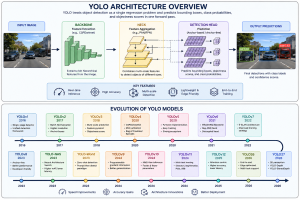
A typical YOLO model consists of three primary components:
- Backbone
The backbone extracts hierarchical image features.
Examples include:
- Darknet-53
- CSPDarkNet
- EfficientRep
- CSPNet
⸻
- Neck
The neck aggregates features across different scales, enabling better detection of both small and large objects.
Popular neck architectures include:
- PAN
- FPN
- Rep-PAN
⸻
- Detection Head
The detection head predicts:
- Bounding box coordinates
- Object confidence
- Class probabilities
Recent versions support anchor-free prediction, simplifying training and improving performance.
⸻
YOLO Family Timeline
Year Model Major Innovation
2016 YOLOv1 Single-stage detection
2017 YOLOv2 BatchNorm, Anchor Boxes
2018 YOLOv3 Multi-scale detection
2020 YOLOv4 CSPDarkNet, Mish
2020 YOLOv5 PyTorch ecosystem
2021 YOLOv6 EfficientRep Backbone
2022 YOLOv7 E-ELAN architecture
2023 YOLOv8 Anchor-free design
2023 YOLO-NAS Neural Architecture Search
2024 YOLO-World Zero-shot detection
2024 YOLOv9 Programmable gradients
2024 YOLOv10 NMS-free inference
2024 YOLOv11 Unified multi-task vision
2025 YOLOv12 Attention-centric architecture
2026 YOLO26 Edge optimization
2026 YOLO27 3D perception & depth estimation
⸻
Comparing Every YOLO Generation
Version Speed Accuracy Edge Deployment Best For
YOLOv3 ★★★ ★★★ ★★★ Research
YOLOv5 ★★★★ ★★★★ ★★★★★ Production
YOLOv7 ★★★★★ ★★★★★ ★★★★ Industrial AI
YOLOv8 ★★★★★ ★★★★★ ★★★★★ Developers
YOLO-NAS ★★★★★ ★★★★★ ★★★★ Custom datasets
YOLOv10 ★★★★★ ★★★★★ ★★★★★ Real-time edge AI
YOLOv11 ★★★★★ ★★★★★ ★★★★★ Multi-task AI
YOLO27 ★★★★★ ★★★★★ ★★★★★ Robotics & 3D Vision
⸻
YOLO vs Faster R-CNN
Feature YOLO Faster R-CNN
Detection Speed Excellent Moderate
Latency Very Low Higher
FPS High Low
Edge Deployment Excellent Difficult
Accuracy Excellent Excellent
YOLO dominates applications requiring real-time inference.
⸻
YOLO vs SSD
Both are single-shot detectors, but YOLO generally provides:
- Better localization
- Higher mAP
- Better community support
- Larger ecosystem
- Faster improvements
⸻
YOLO vs DETR
Transformer-based DETR models eliminate hand-crafted components such as anchor boxes and NMS while improving contextual understanding.
Advantages of DETR:
- Better long-range relationships
- Simpler post-processing
- Stronger accuracy
Advantages of YOLO:
- Lower latency
- Smaller models
- Faster deployment
- Better edge performance
⸻
YOLO vs RF-DETR
Recent transformer-based architectures such as RF-DETR have demonstrated:
- Higher Average Precision
- Better transfer learning on custom datasets
- Strong performance with fewer labeled images
- Apache 2.0 licensing, reducing commercial deployment friction
YOLO remains an outstanding choice for many real-time applications, while RF-DETR is increasingly attractive for projects prioritizing maximum detection accuracy.
⸻
Understanding Object Detection Metrics
IoU (Intersection over Union)
Measures how closely a predicted bounding box overlaps the ground truth annotation.
Higher IoU indicates better localization quality.
⸻
Precision
Precision answers:
Of all predicted detections, how many were correct?
Higher precision means fewer false positives.
⸻
Recall
Recall answers:
Of all actual objects, how many did the model detect?
Higher recall reduces missed detections.
⸻
mAP (Mean Average Precision)
mAP summarizes detection performance across all object classes and IoU thresholds. It remains the most widely used benchmark for comparing object detection models.
⸻
Preparing a Custom Dataset
Successful object detection depends on high-quality labeled data.
Recommended workflow:
- Collect diverse images
- Annotate every object accurately
- Balance class distribution
- Split into train, validation, and test sets
- Review labels for consistency
⸻
Data Annotation Best Practices
High-quality annotations should:
- Enclose objects tightly
- Avoid excessive background
- Maintain consistent class names
- Include varied lighting and viewpoints
- Cover different object scales
Popular annotation formats include YOLO TXT, COCO JSON, and Pascal VOC XML.
⸻
Data Augmentation Techniques
Augmentation improves model generalization by exposing it to more diverse training examples.
Common techniques include:
- Horizontal flip
- Vertical flip
- Random crop
- Rotation
- Scaling
- Mosaic augmentation
- MixUp
- Color jitter
- Blur
- Noise injection
⸻
Transfer Learning
Rather than training from scratch, most projects start with pretrained weights and fine-tune them on a custom dataset. This approach:
- Reduces training time
- Requires fewer labeled images
- Improves accuracy
- Lowers computational cost
⸻
Hyperparameter Optimization
Key hyperparameters include:
- Learning rate
- Batch size
- Number of epochs
- Weight decay
- Optimizer
- Image resolution
- Data augmentation settings
Careful tuning can significantly improve model performance.
⸻
PyTorch (Ultralytics) Training Example
from ultralytics import YOLO
model = YOLO(“yolo11n.pt”)
model.train(
data=”dataset.yaml”,
epochs=100,
imgsz=640,
batch=16
)
⸻
Running Inference
from ultralytics import YOLO
model = YOLO(“best.pt”)
results = model(“test.jpg”)
results[0].show()
⸻
Exporting the Model
model.export(format=”onnx”)
model.export(format=”engine”)
model.export(format=”coreml”)
model.export(format=”openvino”)
Supported deployment targets include ONNX, TensorRT, CoreML, OpenVINO, and others, enabling inference across cloud, desktop, mobile, and embedded platforms.
⸻
Deploying on Edge Devices
YOLO models are well suited for edge AI hardware such as:
- NVIDIA Jetson
- Raspberry Pi (optimized variants)
- Intel OpenVINO platforms
- Qualcomm AI processors
- Coral TPU (with supported conversions)
Their lightweight design enables real-time inference with limited compute resources.
⸻
Industry Applications
YOLO is widely used in:
- Autonomous driving
- Industrial automation
- Healthcare imaging
- Retail analytics
- Agriculture
- Logistics
- Robotics
- Drone navigation
- Smart cities
- Wildlife monitoring
- Construction safety
- Security surveillance
⸻
Advantages
- Extremely fast inference
- Real-time processing
- Lightweight deployment
- Strong open-source ecosystem
- Extensive documentation
- Broad community support
- Easy customization
- Multi-task capabilities
- Cross-platform compatibility
⸻
Limitations
- Performance can decline on extremely small or densely packed objects.
- Heavy occlusions remain challenging.
- Some recent implementations use licenses that may require careful evaluation for commercial deployment.
- Transformer-based detectors often achieve higher accuracy on demanding benchmarks.
⸻
Future Trends
The next generation of object detection is expected to focus on:
- Vision-language models
- Foundation vision models
- 3D perception
- Multi-modal AI
- Better edge optimization
- Self-supervised learning
- Zero-shot recognition
- Real-time scene understanding
YOLO27’s expansion into depth estimation reflects this broader shift toward spatial AI.
⸻
Frequently Asked Questions (FAQ)
What does YOLO stand for?
YOLO stands for You Only Look Once, reflecting its single-pass object detection approach.
Is YOLO good for beginners?
Yes. Frameworks such as Ultralytics make training and deployment straightforward for newcomers.
Which YOLO version should I use?
It depends on your goals. Recent versions like YOLOv10, YOLOv11, YOLO26, and YOLO27 are suitable for modern projects, while earlier versions remain valuable for learning and compatibility.
Can YOLO detect multiple objects?
Yes. YOLO can detect multiple object classes simultaneously within a single image or video frame.
Does YOLO work on videos?
Yes. YOLO supports real-time video inference, making it suitable for surveillance, traffic monitoring, robotics, and industrial automation.
Can YOLO run on mobile devices?
Yes. Optimized models can be deployed on Android, iOS, and embedded hardware using formats such as TensorRT, CoreML, ONNX, and OpenVINO.
Is YOLO suitable for commercial products?
Many YOLO implementations are open source, but licensing varies by project. Always review the license terms of the specific implementation you intend to use, particularly for commercial deployments.
⸻
Conclusion
YOLO has fundamentally reshaped computer vision by making high-speed, end-to-end object detection practical for real-world applications. From its origins as a pioneering single-stage detector to the latest generations supporting segmentation, pose estimation, and 3D perception, the YOLO family continues to evolve alongside the broader AI landscape.
While transformer-based approaches are setting new benchmarks for accuracy, YOLO remains one of the most practical, accessible, and versatile frameworks for developers, researchers, and enterprises alike. Its combination of speed, community support, deployment flexibility, and continuous innovation ensures that it will remain a cornerstone of real-time computer vision for years to come.
⸻
Internal Linking Suggestions
To strengthen topical authority and improve on-site SEO, consider linking this article to related content such as:
- How to Train a Custom YOLO Model
- Complete Guide to Computer Vision
- Object Detection vs Image Classification
- RF-DETR Explained
- OpenCV Tutorial for Beginners
- Edge AI Deployment Guide
- AI in Autonomous Vehicles
- AI for Smart Manufacturing
- Understanding Neural Networks
- PyTorch vs TensorFlow for Computer Vision
⸻
Suggested Schema Markup (JSON-LD)
{
“@context”: “https://schema.org”,
“@type”: “TechArticle”,
“headline”: “The Ultimate Guide to YOLO Models”,
“description”: “Comprehensive guide covering YOLO architecture, evolution, comparisons, applications, and best practices for real-time object detection.”,
“author”: {
“@type”: “Person”,
“name”: “Praful Kumar”
},
“keywords”: [
“YOLO”,
“YOLO Models”,
“Object Detection”,
“Computer Vision”,
“Artificial Intelligence”,
“Deep Learning”,
“PyTorch”,
“Vision AI”
],
“about”: {
“@type”: “Thing”,
“name”: “Object Detection”
}
}
⸻
Tags: YOLO, YOLO Models, YOLOv1, YOLOv2, YOLOv3, YOLOv4, YOLOv5, YOLOv6, YOLOv7, YOLOv8, YOLO-NAS, YOLO-World, YOLOv9, YOLOv10, YOLOv11, YOLOv12, YOLO26, YOLO27, Object Detection, Computer Vision, Artificial Intelligence, Machine Learning, Deep Learning, PyTorch, Ultralytics, OpenCV, RF-DETR, Edge AI, Autonomous Vehicles, Robotics, Image Recognition, Vision AI, AI Applications, Neural Networks, COCO Dataset, mAP, IoU
About The Author